Sponsored by

SPD-BEEHIIV:37f89dcb-9d3b-4df6-ac7c-c5994aecedfc:R11:c75e4e4ee49f0aa904b72675Amazon has blocked Muse from shopping, showing that retailer consent can still constrain personal AI agents.
| Daily issue / By the Numbers | Tuesday, September 22, 2026 |
| | Our toolsSuperpower ChatGPT/WFH.team/Snipman | Today's briefing What matters todayMeta’s Muse has opened with strong download estimates, but Amazon’s shopping block shows that agent adoption and agent access are different contests. Elsewhere, AI training, surveillance accountability, and edge hardware all put human oversight and real-world constraints back at the center. | Inside today's briefing | | 01 | Apptopia estimates Muse drew 1.8 million iOS downloads in the U.S. and Canada in 12 days, ahead of ChatGPT’s 1.3 million. | | 02 | Amazon says Muse accessed its marketplace without disclosure and has asked Meta to remove Amazon from the agent’s experience. | | 03 | OpenAI expanded Academy with role-based courses that teach users what to delegate, what to verify, and who owns the result. | | 04 | An MIT Technology Review investigation found more than 1,050 deaths within advertised range of U.S. border-surveillance towers. |
|
 | Lead story / products Meta’s Muse tops ChatGPT in early iOS downloadsMeta’s Muse has outpaced ChatGPT’s early mobile download pace in a matched iOS comparison for the U.S. and Canada, according to estimates from app-intelligence firm Apptopia. The firm puts Muse at 1.8 million iOS downloads in its first 12 days, compared with 1.3 million for ChatGPT over the equivalent post-launch period. That is an early advantage in a selected regional and platform slice, not a worldwide verdict on the two products. Apptopia’s activity estimates point in the same direction. It put Muse at 642,000 daily active mobile users in the U.S., versus 231,000 for ChatGPT at the comparable point after launch; Muse had an estimated 359,000 active iOS users. Muse also logged an estimated 2.8 million global installs in its first 12 days, though Meta has not published its own early usage figures. The comparison has important limits. ChatGPT’s initial mobile launch was global but iOS-only, while Muse is available on iOS and Android in the U.S. and Canada. Apptopia isolated iOS downloads in those two countries to make the download comparison more comparable, but the launch strategies still were not identical. Muse is designed to take actions, not only answer questions: Meta says it can send email, book travel, and fill out forms while seeking approval before sensitive actions. More than 95% of estimated Muse users also use Facebook and 63% use Instagram, a pattern consistent with Meta’s existing consumer footprint. The next meaningful measure is whether early installs become sustained use for an agent people must trust with more of their digital lives. Read full story ↗ |
|
Pass the Kubernetes exam on your first attempt.
RBAC. Networking. Storage. KodeKloud breaks these complex Kubernetes concepts down into hands-on practice, until you are ready to ace your exam.
Provision live clusters, drain nodes, debug failing pods, fix networking, set up storage. Every concept is explained in plain language before you type a command.
The curriculum is built backwards from the exam objectives and the work you will do on the job. Nothing extra. The scenarios you practice are the ones the exams test, and the ones you hit in production.
Challenges, hands-on labs, and crash courses teach beginners to think like a Kubernetes engineer from day one. Advanced labs go deeper into security, scaling, and complex troubleshooting. Every lab runs on real infrastructure with automated validation.
You're not memorizing answers. You're solving real Kubernetes problems. Starting from zero or sharpening what you have, this is certification prep that sticks.
 | A tool for your workflowSnipmanSave your best replies once, then insert complete answers wherever you work. | | | |
|
 | launch OpenAI adds role-based AI courses and assessmentsOpenAI expanded its Academy with learning paths for knowledge workers, developers, leaders, educators, and college students. The courses move from prompting to reusable workflows and agent delegation, with explicit review checkpoints and human ownership. Learners can earn a badge after passing an assessment, though OpenAI has not said what the assessments measure or how employers and schools should interpret them. Continue reading ↗ |
 | policy Investigation finds 1,050 deaths within border tower rangeMIT Technology Review mapped nearly 4,000 migrant-death locations and found more than 1,050 within the advertised range of U.S. border-surveillance towers. The 15-month investigation combined public records, tower data, and manually checked AI-assisted coordinate extraction. Proximity does not establish a detection or response failure, and incomplete records and limited footage retention constrain accountability. Continue reading ↗ |
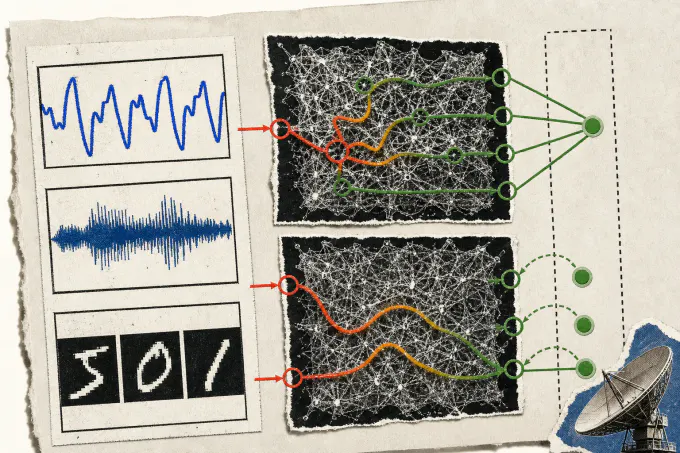 | research Researchers review AI hardware that can learn at the edgeA Nature Reviews Physics article examines nanowire and nanoparticle networks whose changing physical connections can perform computation and learning. The proposed use is local data filtering and pattern recognition for satellites, robots, vehicles, and sensors with limited power or connectivity. The systems have completed real-time speech and image-recognition benchmarks, but remain a research platform rather than a deployed replacement for silicon or cloud computing. Continue reading ↗ |
|
You're Running Three Databases. You Only Need One.
Events in one database, embeddings in another, analytics in a third. That's three systems and the pipelines between them, for one app. TimescaleDB does all three in Postgres: hypertables, pgvector, continuous aggregates. One system, no pipeline, no drift.
| Daily tool drop 6 AI tools worth knowing today | |
| | | The Internet Had a Point | From the timelineGPT-6 Astra’s calendar portrait |  |
| |
| Reader check-in Help shape tomorrow's briefingOne click tells us what to keep, improve, or tighten. | |
| Prefer one email a week? Get the essential AI moves in the Sunday Weekly Digest. |
|